
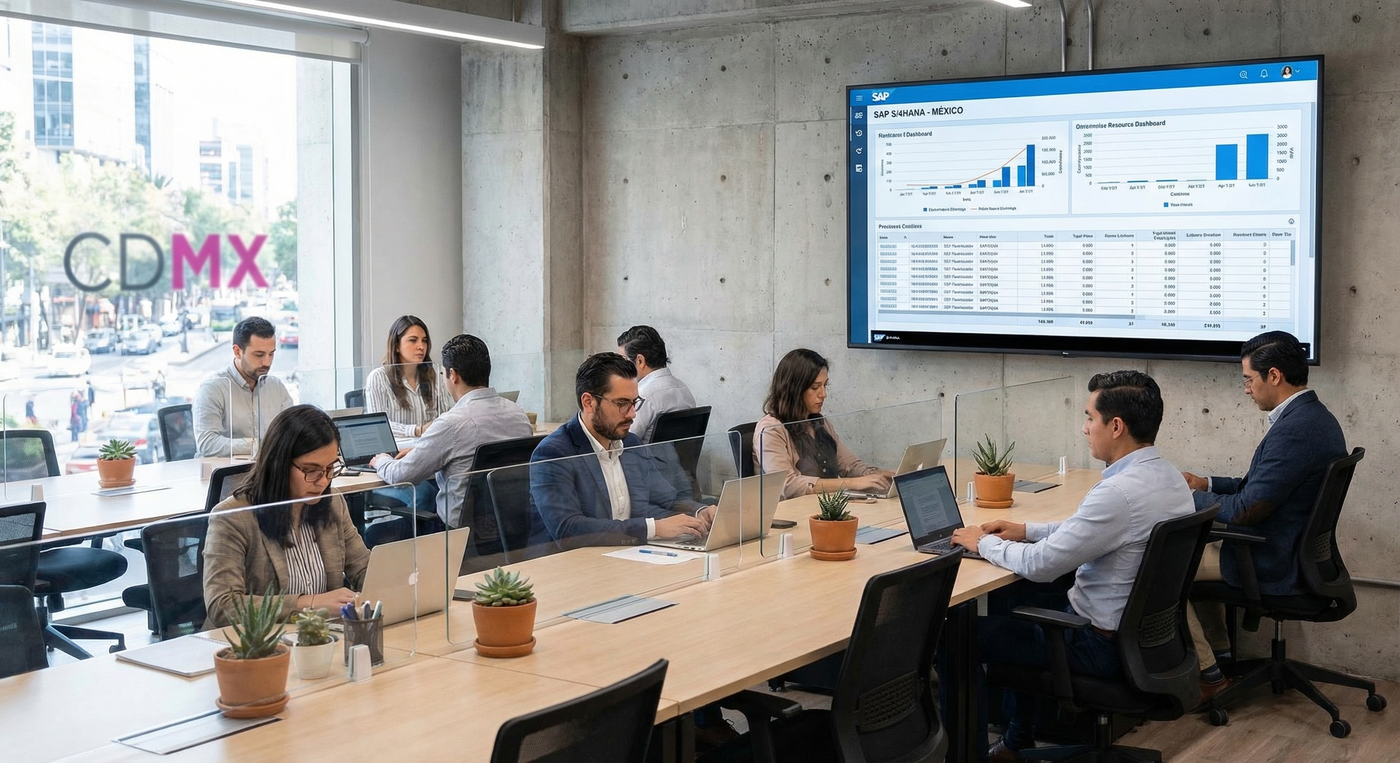
SAP S/4HANA Migration: Complete Checklist for Companies
Migration to SAP S/4HANA is no longer optional for companies running SAP ECC. With SAP ending mainstream maintenance for ECC 6.0 in 2027, organizations that delay their migration face escalating risks: unsupported systems, security vulnerabilities, inability to adopt new innovations, and increasingly expensive custom maintenance agreements. According to SAP's own data, over 30,000 customers worldwide still need to migrate, and the window for orderly transitions is narrowing rapidly.
For Mexican enterprises specifically, S/4HANA migration intersects with critical regulatory changes including CFDI 4.0 compliance, Carta Porte requirements, and evolving SAT digital audit standards. Planning your migration with these factors in mind is not just advisable -- it is essential for operational continuity.
This guide provides a comprehensive, phase-by-phase checklist based on real migration projects executed across manufacturing, retail, and distribution companies in Mexico, with budgets ranging from $500,000 USD to over $5 million USD.
Why Migrate to S/4HANA: The Business and Technical Case
Technical Benefits That Drive Performance
SAP S/4HANA represents a fundamental architectural shift from the traditional SAP ECC platform. Built natively on the SAP HANA in-memory database, it eliminates the need for separate aggregate tables, indexes, and materialized views that characterize ECC deployments:
- 10x to 100x faster processing: Real-world benchmarks show MRP runs that took 8 hours in ECC completing in under 20 minutes on S/4HANA. Financial closing cycles that required weekend batch runs now execute in real time
- Simplified data model: S/4HANA consolidates 26 financial tables into a single Universal Journal (ACDOCA), reducing data footprint by up to 75% and eliminating reconciliation between modules
- Real-time analytics: Embedded analytics remove the need for separate BW extracts for operational reporting. Users access live transactional data through Fiori dashboards without impacting system performance
- Cloud-native architecture: Whether deployed on-premise, in private cloud (RISE with SAP), or public cloud, S/4HANA supports modern DevOps practices, API-first integrations, and microservices extensibility
- Modern UX with SAP Fiori: Role-based applications replace the traditional SAP GUI, reducing training time by 40% and improving user adoption rates significantly
Business Benefits With Quantified Impact
Beyond technology, S/4HANA delivers measurable business outcomes that justify the investment:
- Faster financial close: Companies report reducing month-end close from 10+ days to 2-3 days, freeing finance teams for analysis rather than reconciliation
- Inventory optimization: Real-time material ledger and embedded planning tools reduce safety stock requirements by 15-25%, directly improving working capital
- Procurement efficiency: Intelligent automation in sourcing and purchasing reduces manual touchpoints by 60%, with machine learning predicting optimal purchase timing
- Revenue recognition: Automated compliance with IFRS 15 and ASC 606 revenue recognition standards, critical for publicly traded Mexican companies
- Regulatory compliance: Native support for Mexican CFDI 4.0 electronic invoicing, complemento de pago, and Carta Porte through SAP Document Compliance
| Metric | SAP ECC Average | S/4HANA Average | Improvement |
|---|---|---|---|
| MRP processing time | 4-8 hours | 15-45 minutes | 85-95% |
| Financial close cycle | 8-12 days | 2-4 days | 60-75% |
| Report generation | 30-90 minutes | Real-time | 95%+ |
| User training time | 40-60 hours | 15-25 hours | 50-60% |
| System downtime annually | 40-80 hours | 8-16 hours | 70-80% |
| Integration development | 4-8 weeks per interface | 1-2 weeks with APIs | 70-80% |
The Three Migration Routes: Choosing Your Path
Selecting the right migration approach is the single most consequential decision in your S/4HANA project. Each path has distinct implications for timeline, budget, risk, and business disruption.
1. New Implementation (Greenfield)
A greenfield approach means building your S/4HANA system from scratch, reimagining business processes, and selectively migrating master data and historical transactions.
Timeline: 12-24 months Budget range: $1.5M - $5M+ USD depending on scope and complexity Best for: Companies with heavily customized ECC systems (500+ Z-programs), those undergoing organizational restructuring, or businesses that need to fundamentally redesign processes Advantages:- Clean slate to adopt SAP best practices and eliminate technical debt
- Opportunity to simplify the process landscape and reduce total cost of ownership
- Full access to S/4HANA innovations from day one without legacy constraints
- Chance to consolidate multiple ECC instances into a single S/4HANA system
- Highest initial investment and longest timeline
- Requires comprehensive data migration strategy and validation
- Business disruption during transition period
- Risk of losing institutional knowledge embedded in current system configurations
2. System Conversion (Brownfield)
A brownfield migration converts your existing ECC system to S/4HANA, preserving customizations, configurations, historical data, and transactional history.
Timeline: 6-12 months Budget range: $500K - $2M USD Best for: Companies satisfied with current processes, those with limited customizations, or organizations that cannot tolerate extended data-loss windows Advantages:- Preserves all historical data, configurations, and custom developments
- Shorter timeline and lower initial cost
- Minimal business disruption with proper planning
- Users retain familiarity with existing transactions and processes
- Carries forward technical debt and legacy customizations
- Some Z-programs may require adaptation for S/4HANA compatibility
- Limited opportunity to optimize business processes during conversion
- Custom code remediation can be extensive if the system has 1000+ Z-objects
3. Selective Data Transition (Bluefield / Hybrid)
The selective data transition combines elements of both approaches, allowing companies to selectively choose which data, configurations, and customizations to bring forward.
Timeline: 9-18 months Budget range: $800K - $3M USD Best for: Companies needing to restructure their organizational model while preserving specific historical data, or those consolidating multiple ECC systems Advantages:- Flexibility to redesign some processes while preserving others
- Selective data migration reduces the "all or nothing" risk
- Can consolidate multiple systems while maintaining data continuity
- Good option for companies undergoing mergers or restructuring
- Requires sophisticated data migration tooling (SNP CrystalBridge, Syniti)
- More complex project management than pure greenfield or brownfield
- Requires clear decisions on what to keep versus redesign
| Factor | Greenfield | Brownfield | Selective / Hybrid |
|---|---|---|---|
| Timeline | 12-24 months | 6-12 months | 9-18 months |
| Budget | $1.5M - $5M+ | $500K - $2M | $800K - $3M |
| Data preservation | Selective | Complete | Selective |
| Process optimization | Maximum | Limited | Moderate |
| Business disruption | High | Low-Medium | Medium |
| Technical debt cleanup | Complete | Minimal | Moderate |
| Custom code impact | Rebuild | Remediate | Selective |
| Risk level | Medium-High | Low-Medium | Medium |
Phase-by-Phase Migration Checklist
Phase 1: Discovery and Assessment (Weeks 1-8)
This phase establishes the foundation for every subsequent decision. Shortcuts here create compounding problems later.
System Assessment:- [ ] Run SAP Readiness Check to identify S/4HANA compatibility gaps
- [ ] Execute custom code analysis using SAP Custom Code Migration Worklist
- [ ] Document all interfaces (RFC, IDoc, BAPI, web services) with external systems
- [ ] Inventory all add-ons, ISV solutions, and third-party integrations
- [ ] Assess database size and growth projections for hardware sizing
- [ ] Review current system performance baselines for post-migration comparison
- [ ] Map all active business processes across FI/CO, MM, SD, PP, and industry modules
- [ ] Identify processes requiring redesign versus those to migrate as-is
- [ ] Document all regulatory processes: CFDI 4.0 stamping, Carta Porte, SAT audit trails
- [ ] Review reporting requirements and identify gaps between current and S/4HANA analytics
- [ ] Assess change management readiness across departments
- [ ] Evaluate on-premise versus [cloud deployment](/blog/aws-azure-migration-guide-mexican-companies) options (RISE with SAP, Azure, AWS)
- [ ] Size HANA database requirements based on current data footprint
- [ ] Plan network architecture for HANA replication and disaster recovery
- [ ] Assess cybersecurity requirements and data residency regulations
Phase 2: Planning and Design (Weeks 9-16)
Migration Strategy:- [ ] Select migration approach (greenfield, brownfield, or selective)
- [ ] Define project governance structure with executive sponsor, steering committee
- [ ] Establish project timeline with key milestones and go/no-go decision points
- [ ] Create detailed budget with contingency (recommend 20-25% buffer)
- [ ] Define cutover strategy and acceptable downtime window
- [ ] Design target S/4HANA architecture (system landscape, transports, environments)
- [ ] Plan custom code remediation roadmap prioritized by business criticality
- [ ] Design [integration architecture](/servicios/) for all connected systems
- [ ] Plan data migration strategy including cleansing, transformation, and validation rules
- [ ] Design security model including roles, authorizations, and data privacy controls
- [ ] Configure CFDI 4.0 electronic invoicing with certified PAC provider
- [ ] Design Carta Porte complemento workflows for logistics operations
- [ ] Plan complemento de pago automation for payment reconciliation
- [ ] Configure SAT audit file generation (contabilidad electronica)
- [ ] Design DIOT (informativa de operaciones con terceros) reporting
- [ ] Plan IEPS and withholding tax configurations per Mexican fiscal requirements
Phase 3: Build and Configure (Weeks 17-32)
System Configuration:- [ ] Install and configure S/4HANA system landscape (Development, QA, Production)
- [ ] Execute organizational structure configuration (company codes, plants, sales orgs)
- [ ] Configure financial accounting with Mexican chart of accounts
- [ ] Set up material management, sales and distribution, and production planning
- [ ] Implement custom code remediations validated in development environment
- [ ] Build and test all interfaces with external systems (banking, logistics, CRM)
- [ ] Configure middleware (SAP PI/PO, CPI, or third-party) for integration orchestration
- [ ] Develop API-based integrations for modern connected systems
- [ ] Test [order management](/blog/order-management-system-what-why-need) and fulfillment integrations end-to-end
- [ ] Execute data cleansing in source system before migration
- [ ] Develop and test data migration programs for master data (customers, vendors, materials)
- [ ] Develop and test transactional data migration (open orders, open invoices, balances)
- [ ] Perform trial data migration with full validation cycles (minimum 2-3 iterations)
Phase 4: Testing (Weeks 33-40)
- [ ] Execute unit testing for all configured processes and custom developments
- [ ] Conduct integration testing across all module boundaries and external interfaces
- [ ] Perform user acceptance testing (UAT) with business process owners
- [ ] Execute performance testing under production-equivalent load
- [ ] Conduct regression testing of all Mexican regulatory processes (CFDI, Carta Porte, SAT)
- [ ] Validate reporting accuracy against ECC baseline data
- [ ] Test disaster recovery and business continuity procedures
- [ ] Conduct security penetration testing and authorization validation
Phase 5: Cutover and Go-Live (Weeks 41-44)
- [ ] Execute dress rehearsal cutover with full data migration and validation
- [ ] Confirm go/no-go with steering committee based on test results
- [ ] Execute production cutover per approved plan
- [ ] Validate all critical business processes in production within first 24 hours
- [ ] Monitor system performance and transaction throughput during hypercare
- [ ] Confirm regulatory compliance: first CFDI stamps, Carta Porte documents, bank reconciliations
Phase 6: Post Go-Live Optimization (Months 12-18)
- [ ] Resolve hypercare issues and stabilize system operations
- [ ] Conduct post-implementation review and lessons learned
- [ ] Plan and execute Phase 2 optimizations (advanced analytics, machine learning, automation)
- [ ] Train power users and establish center of excellence
- [ ] Decommission legacy ECC system after data retention period
Mexico Success Cases
Manufacturing Sector: Automotive Parts Manufacturer (Nuevo Leon)
Company profile: Tier-1 automotive supplier with 3 plants in Mexico, 2,500 employees, annual revenue of $180M USD Challenge: ECC system running since 2008 with 800+ custom Z-programs, unable to meet OEM real-time reporting requirements, struggling with CFDI 4.0 compliance deadlines Migration approach: Brownfield conversion with selective custom code remediation Timeline: 10 months from project kickoff to go-live Budget: $1.2M USD Results after 12 months:- MRP processing reduced from 6 hours to 25 minutes (93% improvement)
- Month-end financial close reduced from 12 days to 3 days
- CFDI 4.0 stamping fully automated with 99.8% first-attempt success rate
- $450,000 USD annual savings in IT operations and maintenance costs
- Real-time production reporting enabled per OEM requirements
Retail Sector: National Convenience Store Chain
Company profile: 1,200+ stores across Mexico, $500M USD annual revenue, complex distribution network Challenge: Unify fragmented inventory management across regions, implement [SAP Retail modules](/blog/sap-retail-modules-optimize-inventory) for demand forecasting, and integrate omnichannel order fulfillment Migration approach: Greenfield implementation to redesign retail processes Timeline: 18 months Budget: $3.8M USD Results after 12 months:- 50% reduction in month-end close cycle (from 14 days to 7 days)
- 35% improvement in inventory accuracy across all stores
- Stockout reduction of 42% through automated replenishment
- $2.1M USD annual savings in inventory carrying costs
- Carta Porte compliance automated for 100% of distribution movements
Distribution Sector: Industrial Supplies Distributor (Guadalajara)
Company profile: B2B distributor serving manufacturing sector, 15,000+ SKUs, $95M USD annual revenue Challenge: Legacy ECC unable to support e-commerce integration, manual order processing causing fulfillment delays, limited visibility into real-time inventory positions Migration approach: Selective data transition (hybrid) Timeline: 14 months Budget: $1.6M USD Results after 12 months:- Order processing time reduced by 65% through automation
- E-commerce integration enabled same-day order fulfillment for 80% of orders
- Working capital improved by $3.2M USD through inventory optimization
- Customer satisfaction scores increased from 72% to 91%
Common Migration Pitfalls and How to Avoid Them
Based on our experience across 20+ S/4HANA migrations in Mexico, these are the most frequent causes of project delays and budget overruns:
1. Underestimating custom code remediation: Companies with 500+ Z-programs routinely underestimate remediation effort by 40-60%. Invest in thorough custom code analysis during the discovery phase.
2. Neglecting data quality: Poor master data quality causes cascading failures during testing. Budget dedicated data cleansing effort before migration, not during.
3. Insufficient testing of Mexican regulatory processes: CFDI stamping, Carta Porte, and SAT compliance must be tested exhaustively. A single PAC configuration error can halt invoicing operations post go-live.
4. Change management as afterthought: User adoption is the top risk factor. Budget for comprehensive training programs with role-specific curricula, not generic overview sessions.
5. Inadequate infrastructure sizing: HANA database performance is sensitive to proper sizing. Under-provisioned systems create performance bottlenecks that undermine the business case.
Investment and ROI Framework
Typical Migration Investment (Mexican Market)
| Company Size | Employees | Migration Budget | Annual TCO Savings | Payback Period |
|---|---|---|---|---|
| Mid-market | 500-2,000 | $500K - $1.5M USD | $150K - $400K | 2-4 years |
| Large enterprise | 2,000-10,000 | $1.5M - $5M USD | $500K - $1.5M | 2-3 years |
| Corporate group | 10,000+ | $5M - $15M+ USD | $2M - $5M+ | 2-3 years |
ROI Components
Hard savings: IT infrastructure reduction (30-50%), license optimization, reduced manual processing, faster close cycles, inventory optimization Soft savings: Better decision-making through real-time data, improved customer satisfaction, regulatory compliance risk reduction, employee productivity gains Strategic value: Platform for innovation (AI, machine learning, IoT integration), competitive differentiation, M&A readiness, talent attractionConclusion: Your Migration Starts With the Right Partner
S/4HANA migration is the most significant IT investment most Mexican companies will undertake this decade. The complexity is real, but so are the rewards. Companies that migrate successfully report transformational improvements in operational efficiency, regulatory compliance, and competitive positioning.
The critical success factors are clear: thorough assessment, realistic planning, disciplined execution, and an experienced implementation partner who understands both SAP technology and the Mexican business landscape.
At [iTechDev](/servicios/) we bring deep expertise in S/4HANA migrations for Mexican enterprises across manufacturing, retail, and distribution. Our team has delivered 20+ successful migrations, with a 100% go-live success rate and average ROI achievement within 24 months.
Ready to plan your S/4HANA migration? [Contact our SAP team](/contacto) for a complimentary migration readiness assessment. We will analyze your current ECC landscape, recommend the optimal migration path, and provide a detailed investment estimate -- at no cost and no obligation.